

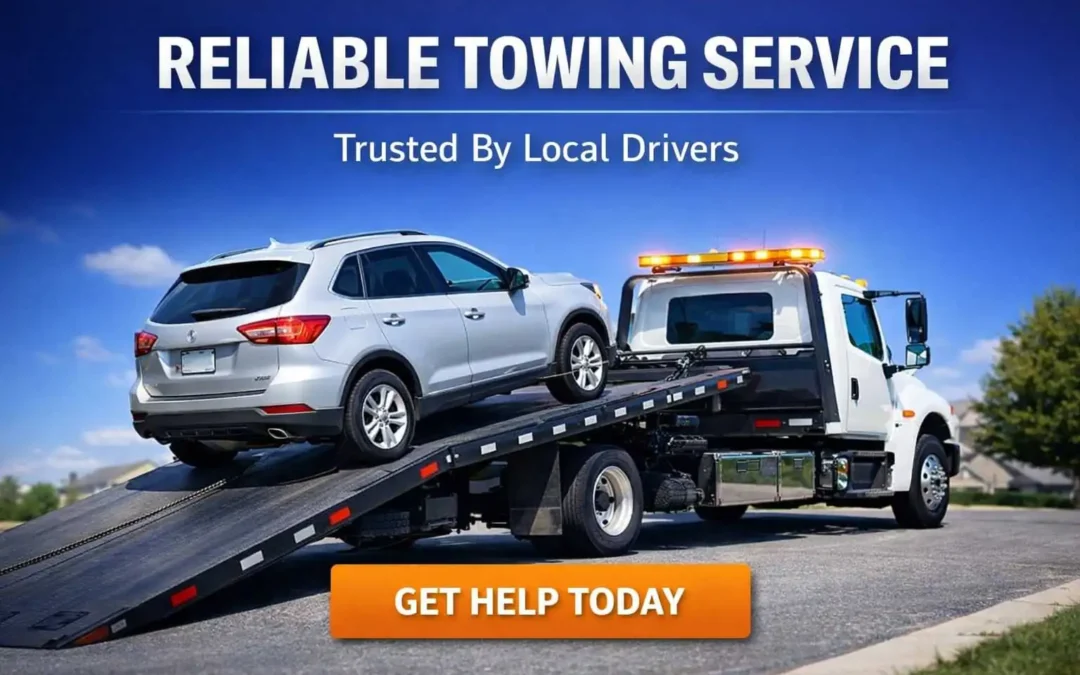
🔗 Quick Answer: A winching service uses a motorised cable system mounted on a tow truck to pull your vehicle out of a situation where the wheels cannot get traction — ditches, mud, snow, embankments, soft shoulders, and flooded terrain. Unlike standard towing, which transports a vehicle from one location to another, car winching recovers the vehicle back to driveable ground so it can either be driven away or loaded for towing. If your vehicle is stuck anywhere in the GTA right now, call (647) 812-1477 — Towing Toronto provides 24/7 winching service across Toronto and surrounding areas.
Vehicle stuck in a ditch, mud, or snow? 24/7 car winching across the GTA.
You are driving on a rural road north of the city and the shoulder gives way under your right wheels. The car slides into a shallow ditch, tilts at an angle, and the front tyres spin uselessly in soft earth. You are not hurt, the car is not damaged — but you are going absolutely nowhere under your own power. This is the most common scenario that leads to a winching service call, and most drivers have never experienced it until the moment it happens.
Winching is one of those services most people do not think about until they need it desperately. It is different from towing, it requires different equipment, and knowing how the process works — before your wheels are spinning in mud at 11 PM on a dark country road — can save you time, money, and the kind of panic that leads to bad decisions like trying to rock the car free and digging yourself deeper.
This guide explains what a winching service is, how it differs from regular towing, the step-by-step process a professional operator uses to extract your vehicle, the situations that require winching versus towing, and what you should do (and not do) while waiting for help.
What Is a Winching Service? Winching vs. Towing Explained
Towing and winching are related but fundamentally different operations. Understanding the distinction helps you communicate with the dispatcher and ensures the right equipment arrives:
🔗 Winching
Purpose: Recover a stuck vehicle back to solid, driveable ground.
How it works: A steel cable or synthetic rope, wound on a motorised spool mounted on the tow truck, is attached to a structural point on the stuck vehicle. The winch motor retracts the cable under controlled tension, pulling the vehicle toward the truck and back onto firm ground.
When you need it: Vehicle in a ditch, stuck in mud, buried in snow, off an embankment, on a soft shoulder, in a flooded area, or anywhere the wheels cannot get traction.
After winching: If the vehicle is undamaged and driveable, you drive away. If it needs repair, it is then loaded for towing.
🚛 Towing
Purpose: Transport a vehicle from one location to another.
How it works: The vehicle is loaded onto a flatbed or lifted by a wheel-lift, then driven to a repair shop, home, or other destination.
When you need it: Vehicle will not run (mechanical failure, dead battery, accident damage, flat tyre) but is on solid ground and accessible.
Key difference: Towing requires the vehicle to be on or near a road surface. If it is off the road or stuck, it must be winched back first, then towed.
Many recovery situations require both operations in sequence: the winch pulls the vehicle out of the ditch (recovery), and then the flatbed transports it to the repair shop (towing). When you call for a winching service, the same truck typically handles both operations — the winch cable and the flatbed are part of the same vehicle.
When You Need a Winching Service: Common Stuck-Vehicle Scenarios
Vehicle winching is needed whenever the vehicle’s wheels cannot generate enough traction to move the vehicle under its own power, or when the vehicle has left the road surface entirely. Here are the most common scenarios in the GTA:
Ditch Recovery
The single most common car winching scenario. A vehicle slides off the road into a roadside ditch — sometimes just the right-side wheels, sometimes the entire vehicle. Causes include distracted driving, poor visibility, icy roads, swerving to avoid an animal, and shoulder collapse. The ditch is typically 30–90 cm deep, soft-bottomed, and angled in a way that prevents the vehicle from driving out. The winch cable attaches to the vehicle’s frame or tow hook and pulls it back up the ditch bank onto the road surface.
Stuck in Snow or Ice
Toronto winters produce ice storms, lake-effect snow squalls, and accumulations that can trap vehicles in parking lots, driveways, side streets, and highway shoulders. When spinning wheels polish the snow beneath them into ice, the car sinks deeper with every attempt. Winching is the clean solution — the cable applies linear pulling force that does not depend on tyre traction. During major winter storms, winching calls across the GTA spike dramatically. A dead battery combined with a vehicle stuck in snow is a common double problem — the winch truck handles both. For winter driving safety tips, see our seasonal guide.
Mud and Soft Ground
Construction site access roads, rural properties, cottage driveways after rain, festival grounds, and unpaved parking areas all become mud traps in wet conditions. A passenger car on all-season tyres has almost zero chance of self-extracting from mud deeper than the tread — the tyres simply dig trenches. Vehicle winching pulls the car straight out along the surface rather than relying on the tyres to push it. The operator positions the tow truck on firm ground and runs the cable to the stuck vehicle, sometimes using a snatch block to change the pull angle if the truck cannot line up directly.
Embankment and Slope Recovery
A vehicle that has gone over an embankment or down a slope requires a more complex winching operation. The cable must apply upward pulling force against gravity and the vehicle’s weight on an incline — this demands more winch power and often requires a snatch block (a pulley that doubles the cable back to create a mechanical advantage, effectively doubling the pulling force). Embankment recoveries are the situations where professional equipment and experience matter most — an improperly anchored winch on a slope can pull the recovery truck toward the embankment instead of pulling the stuck vehicle up.
Parking Lot and Driveway Incidents
Not all winching happens on remote roads. In the GTA, some of the most common car winching calls come from urban situations: a vehicle that has driven over a parking curb and is high-centred (chassis resting on the curb, wheels off the ground), a car that has slid off an icy driveway into a yard, or a vehicle that has bottomed out in a pothole or construction trench. These recoveries are usually straightforward — short cable runs, flat terrain — but still require proper equipment to avoid damaging the vehicle’s undercarriage.
Flood Recovery
Toronto has experienced significant urban flooding events that strand vehicles in standing water. A car that has been driven into a flooded underpass or that was parked in a low-lying area during a flash flood cannot be driven out — the engine may be hydrolocked (water drawn into the intake, preventing the pistons from cycling), and the water itself prevents traction. Winching extracts the vehicle from the water, after which it may need flatbed towing to a repair facility for flood damage assessment. If floodwater damage has left the vehicle undriveable, accident towing with direct insurance billing may apply depending on your policy and the cause of the incident.
Stuck Right Now? We Pull You Out.
24/7 car winching service across the GTA. Ditches, mud, snow, embankments — our winch trucks are equipped for every scenario.
How Professional Vehicle Winching Works: The Recovery Process
When a Towing Toronto winch truck arrives at the scene, the operator follows a systematic process designed to extract the vehicle safely without causing additional damage. Here is what happens:
Scene Assessment
Before touching any equipment, the operator assesses the entire scene. What type of terrain is the vehicle stuck in? How deep? At what angle? Is the vehicle resting against anything (tree, boulder, guardrail)? Is there visible damage or fluid leaks? Are there hazards — traffic, slope, water, unstable ground? This assessment determines the winching strategy: which direction to pull, how much cable to deploy, whether a snatch block is needed, and where to position the recovery truck.
Recovery Truck Positioning and Anchoring
The tow truck is positioned on firm, level ground as close to directly in line with the stuck vehicle as possible. A straight-line pull is the safest and most efficient. The truck’s parking brake is engaged and wheel chocks placed. If the angle is not direct, a snatch block is attached to a fixed anchor point (tree, post, or ground anchor) to redirect the cable. The truck must be stable — if the recovery truck moves during winching, the entire operation becomes dangerous.
Cable Attachment to the Stuck Vehicle
The winch cable is run out to the stuck vehicle and attached to a structural recovery point — the factory tow hook (usually behind a small cover panel on the front or rear bumper), a frame-mounted D-ring, or a structural crossmember. The attachment must be to a point designed to handle pulling force. Attaching to a bumper cover, suspension component, or body panel will rip the attachment point off the vehicle before the vehicle moves. The operator uses a rated D-shackle to connect the cable to the hook — never wrapping the cable directly around a component.
Safety Zone Establishment
Before the winch is activated, the operator establishes a safety zone. All people — the vehicle owner, passengers, and bystanders — must stand well clear of the cable path. A winch cable under tension stores enormous energy. If the cable snaps or an attachment point fails, the recoiling cable can cause serious injury. A line damper (a heavy blanket or pad draped over the cable midway) is placed to absorb energy and reduce recoil distance in the event of a break. No one stands over, beside, or in the direct path of the tensioned cable.
Controlled Winching
The operator activates the winch motor using a remote control, keeping distance from the cable. The cable retracts slowly and steadily — no jerking, no sudden loads. The vehicle begins to move toward the truck, pulled across the terrain by the cable. The operator monitors the cable tension, the vehicle’s movement path, and any obstacles. If the vehicle hangs up on something (a rock, a stump, the edge of the ditch), the operator stops, reassesses, and may adjust the pull angle. The stuck vehicle should be in neutral with brakes released so it rolls freely.
Vehicle Assessment and Next Steps
Once the vehicle is back on solid ground, the operator inspects it for damage: undercarriage scrapes, fluid leaks, bent suspension components, tyre damage, and any impact marks. If the vehicle is driveable and undamaged, you can drive away — the winching service is complete. If the vehicle has sustained damage that makes it unsafe to drive (bent wheel, fluid leak, engine or transmission damage), the operator loads it onto the flatbed for towing to a repair facility.
Winching Equipment: What a Professional Winch Truck Carries
A tow truck equipped for vehicle winching carries specific equipment beyond the standard flatbed or wheel-lift setup. Understanding this equipment helps you evaluate whether the tow truck that arrives is actually prepared for a winching job:
For heavier vehicles or more challenging recoveries, heavy-duty towing equipment with higher-capacity winches may be required. When calling for a winching service, describe the vehicle’s approximate weight and the situation — the dispatcher will send the appropriate truck class. For guidance on evaluating towing providers, see our guide to choosing a reliable towing company.
What to Do (and What Not to Do) When Your Vehicle Is Stuck
The decisions you make in the first few minutes after getting stuck determine whether the situation stays simple or becomes expensive. Here is the right approach:
✅ DO
Stop accelerating immediately. The moment your wheels start spinning without the vehicle moving, take your foot off the accelerator. Every second of spinning digs the tyres deeper into the mud, snow, or soft ground — turning a simple extraction into a major recovery.
Assess the situation from inside the vehicle. Before getting out, look at what you can see: how deep are the tyres sunk? Is the vehicle tilted? Is there traffic nearby? Is the ground under the vehicle stable? This information helps the dispatcher send the right equipment.
Turn on hazard lights. Even in a parking lot or rural area, make your vehicle visible. On a road, other vehicles need to see your stationary car.
Call for professional winching service. Call (647) 812-1477 and describe: your location, the type of terrain you are stuck in, how deep, and your vehicle make and model. This allows the dispatcher to send a winch truck with appropriate capacity.
Stay safe while waiting. If on a road, follow the same safety principles as a highway breakdown. If off-road, stay with the vehicle unless there is a specific hazard (rising water, unstable slope). Keep a vehicle emergency kit in your car for situations like this — blankets, flashlight, and a charged phone make the wait safer.
🚫 DON’T
Don’t keep spinning the wheels. This is the number one mistake. Spinning tyres generate heat, dig deeper, and can damage the transmission. In mud, spinning creates polished ruts the tyre cannot climb out of. In snow, it melts the snow under the tyre, which then refreezes as ice.
Don’t let a friend try to pull you out with a pickup truck and a tow strap. Improvised vehicle-to-vehicle pulls are responsible for a significant number of secondary accidents and vehicle damage. A tow strap rated for 2,000 kg being used to pull a 1,800 kg vehicle out of a ditch is operating at the limit — and if the strap snaps, the metal hooks become projectiles.
Don’t rock the vehicle aggressively. Rapidly shifting between drive and reverse puts extreme stress on the transmission, especially in automatic vehicles. If the vehicle does not move within 2–3 gentle attempts, stop. The transmission repair bill will be far more than the winching cost.
Don’t place objects under the wheels and floor the accelerator. Floor mats, branches, or cardboard under the tyres can work in very shallow situations, but in anything deeper than tread height, the objects simply get flung backward at high speed or sucked under the vehicle. More importantly, if the tyres suddenly grab traction, the vehicle lurches forward unpredictably — into whatever is in front of it.
How Much Does a Winching Service Cost in Toronto?
Winching costs vary based on the complexity of the recovery — a car with two wheels in a shallow roadside ditch is a simpler operation than a vehicle that has rolled down a 3-metre embankment into a muddy field. Here are the factors that determine the cost:
Recovery Complexity
Shallow ditch on flat ground with good access = straightforward. Deep embankment with the vehicle at an angle on soft terrain = complex. Multiple snatch block setups, angled pulls, and extended time on scene increase the cost.
Vehicle Weight and Size
A compact car weighs 1,200–1,500 kg. A full-size SUV or pickup is 2,200–3,000+ kg. Heavier vehicles require more winch force and sometimes a larger truck class. The difference between winching a Honda Civic and a Ford F-250 can be significant.
Time and Access
Night calls, rural locations that require travel time, and situations where the recovery truck cannot get close (requiring longer cable runs or additional equipment) all factor into cost. A 15-minute extraction in a Toronto parking lot costs less than a 90-minute embankment recovery on a rural road north of the GTA.
Towing After Winching
If the vehicle needs to be towed after extraction (because it is damaged or undriveable), that is an additional service on top of the winching. If the vehicle is driveable after winching, you only pay for the winch-out. See our towing cost and price guide for towing rates.
All winching service pricing from Towing Toronto complies with Ontario’s TSSEA rate requirements. We provide an estimate before beginning work so you know the cost upfront — no surprise charges after the vehicle is already on the cable. For an exact quote, call (647) 812-1477 and describe the situation. For response time expectations, see our emergency towing response times guide. To understand fair pricing and avoid predatory operators, read our towing scams protection guide.
Towing Toronto Winching Service
Towing Toronto provides car winching and vehicle recovery across the GTA:
Equipped Winch Trucks
Our fleet includes trucks equipped with hydraulic winches rated for light-duty and medium-duty recoveries, plus snatch blocks, rated D-shackles, line dampers, and full cable sets. For heavy-duty winching (trucks, buses, construction equipment), our heavy-duty fleet carries winches with significantly higher capacity.
Every Terrain, Every Situation
Ditches, mud, snow, ice, embankments, parking lot incidents, flooded areas, construction sites, rural properties, and cottage driveways. If your vehicle is stuck, we have recovered vehicles from the same situation before. Our operators know GTA terrain — including which Toronto intersections flood, which rural roads have soft shoulders, and which construction zones trap vehicles regularly.
Winch + Tow in One Call
If your vehicle needs to be winched out and then towed, the same truck handles both. No waiting for a second vehicle. The operator winches you to solid ground, assesses the vehicle, and if it needs towing, loads it directly onto the flatbed. One call, one truck, one operator — from stuck to repair shop.
24/7 Across the GTA
Vehicles get stuck at all hours — ice storms hit overnight, mud traps spring at rural properties on weekends, festival parking lots swallow cars on long weekends. We dispatch winching service 24 hours a day, 7 days a week across Toronto, Scarborough, North York, Etobicoke, Mississauga, Brampton, Markham, and Vaughan.
Frequently Asked Questions
What is a winching service?
A winching service uses a motorised cable system mounted on a tow truck to pull a stuck vehicle back to driveable ground. The winch applies controlled, steady pulling force through a steel cable or synthetic rope attached to a structural point on the vehicle. It is used when the vehicle’s wheels cannot generate enough traction to move — such as in a ditch, mud, snow, on an embankment, or in floodwater. Winching recovers the vehicle’s position; towing then transports it if needed.
How much does car winching cost in Toronto?
Car winching cost depends on the complexity of the recovery, your vehicle’s weight, the terrain, time on scene, and whether towing is also needed afterward. Simple ditch extractions cost less than complex embankment or mud recoveries. All pricing complies with Ontario TSSEA requirements and is provided upfront before work begins. For an exact quote, call (647) 812-1477 and describe the situation.
Will winching damage my car?
When performed by a trained operator using proper equipment and rated attachment points, winching should not damage your vehicle. The cable attaches to the factory tow hook or a structural frame point designed to handle pulling force. The controlled, slow pull avoids shock loading. Damage can occur if the cable is attached to a non-structural point (bumper cover, suspension arm), if the pull is too fast, or if the vehicle drags against an obstacle during extraction. This is why professional winching with experienced operators matters.
My car is stuck in snow in my driveway. Can you winch it out?
Yes. Residential driveway snow extraction is one of the most common winching calls during Toronto winters. The winch truck positions on the street (firm ground) and runs the cable up the driveway to your vehicle. In most cases, the extraction takes less than 20 minutes once the truck arrives. If the driveway is too narrow or steep for the truck to access, the operator uses a longer cable run or a snatch block to redirect the pull.
Can I drive my car after it has been winched out of a ditch?
Often, yes. If the vehicle entered the ditch at low speed and has no visible damage (no fluid leaks, no bent wheels, no broken suspension, no warning lights), it is usually safe to drive. The winch operator will do a visual inspection after extraction and let you know if they see anything concerning. If there is any doubt about the vehicle’s condition — especially if the undercarriage scraped hard or if you hit something going into the ditch — have it towed to a mechanic for a proper inspection rather than driving on a potentially compromised suspension or leaking fluid line.
What is a snatch block and why does the operator use one?
A snatch block is a heavy-duty pulley used in winching operations. The cable routes from the winch to the snatch block (which is attached to a fixed anchor point), and then back to the stuck vehicle. This creates two effects: it changes the pulling direction (so the truck does not have to be directly in line with the stuck vehicle), and it effectively doubles the pulling force by splitting the load across two cable segments. Snatch blocks are used in most embankment recoveries and angled pulls where a straight-line extraction is not possible.
Does insurance cover winching service?
It depends on your policy. Some Ontario auto insurance policies include roadside assistance coverage that covers winching, while others only cover towing. If you went into the ditch because of a collision (another vehicle hit you, you swerved to avoid an obstacle), your collision coverage may apply, and direct insurance billing can handle the cost. Check your specific policy for roadside assistance and towing coverage limits. For fleet vehicles, winching is typically covered under the commercial towing account.
Can you winch out an SUV or pickup truck?
Yes. Our light-duty and medium-duty winch trucks handle vehicles from compact cars through full-size SUVs and pickup trucks. Heavier vehicles like the Ford F-250, Ram 2500, or large SUVs (Suburban, Expedition) are within the capacity of our standard winch equipment. For commercial trucks, buses, or construction vehicles, our heavy-duty towing fleet carries winches with the capacity for vehicles up to and exceeding 10,000 kg.
How long does a winching service take?
Simple extractions — a car with two wheels in a shallow ditch on flat ground — typically take 15–30 minutes from the time the operator begins work. More complex recoveries — vehicles deep in mud, at steep angles on embankments, or requiring multiple snatch block setups — can take 45–90 minutes or more. The operator cannot rush. Slow, controlled winching prevents cable failure, attachment point damage, and additional vehicle damage. The goal is to get the vehicle out safely and intact, not just quickly.
What information should I give the dispatcher when I call for winching?
Give the dispatcher: your exact location (address, intersection, or GPS coordinates), the type of terrain the vehicle is stuck in (ditch, mud, snow, embankment), approximately how deep or how far off the road, the angle the vehicle is sitting at, your vehicle’s make, model, and approximate weight class (compact, midsize, SUV, truck), and whether there are any hazards (traffic, water, slope). This lets the dispatcher send the right truck with the right winch capacity. The more detail you provide, the faster the recovery goes once the truck arrives.
Stuck? We Pull You Out. It’s What We Do.
24/7 car winching and vehicle recovery across Toronto and the GTA. Ditches, mud, snow, embankments, parking lots — our winch trucks are equipped for it all.
Recent Comments