

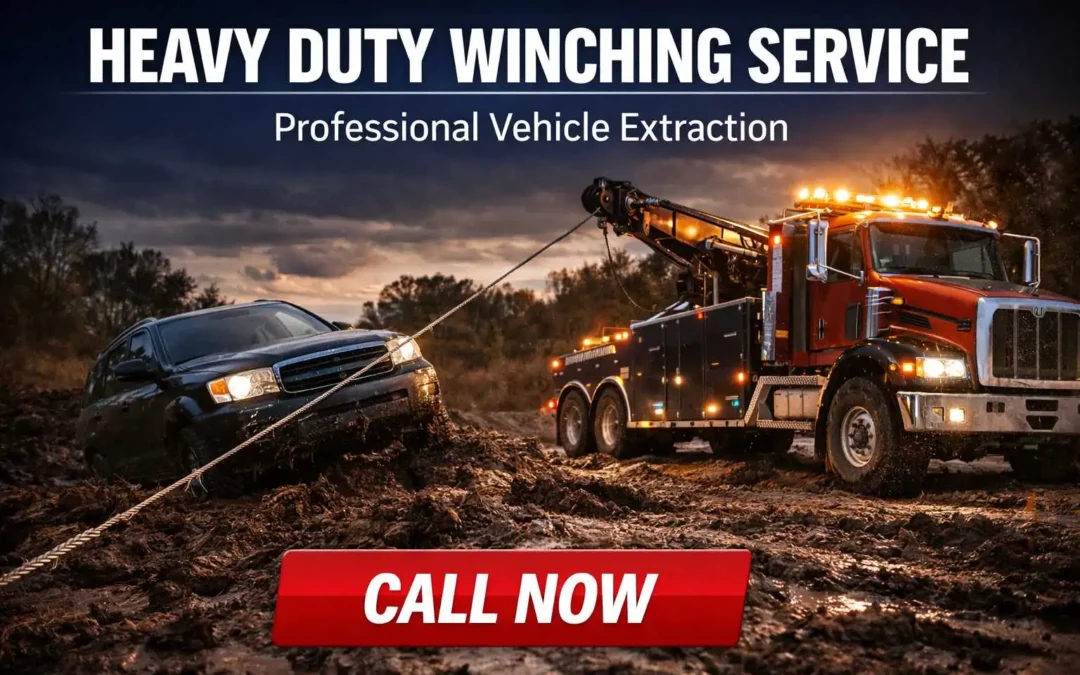
🚛 Quick Answer: Heavy duty towing covers any vehicle over 4,500 kg (10,000 lbs) — including tractor-trailers, dump trucks, buses, construction equipment, and RVs. In Toronto, heavy duty tow service typically costs $350 to $500+ per hour for the wrecker, plus mileage. Towing Toronto (647) 812-1477 operates 50-ton wreckers with air cushion recovery, rotators, and WreckMaster-certified operators for big rig towing and commercial vehicle recovery across the GTA — 24/7, 365 days a year.
Need a heavy wrecker right now? We cover all 400-series highways and the entire GTA.
When a tractor-trailer jackknifes on the 401, a dump truck rolls over on a construction exit ramp, or a transit bus breaks down in rush hour — a regular tow truck cannot handle it. These situations require heavy duty towing: specialized wreckers, certified operators, and equipment that can safely lift, recover, and transport vehicles weighing 10,000 to 80,000+ pounds.
This guide explains how big rig towing and heavy truck recovery works in Toronto, what equipment is used, what it costs, and what to do if your commercial vehicle needs a heavy duty tow on the highway or at a job site.
What Is Heavy Duty Towing?
Towing is generally classified into three weight categories. The distinction matters because each requires different trucks, equipment, and operator training:
A loaded tractor-trailer can weigh up to 63,500 kg (140,000 lbs) on Ontario highways. Recovering one that has overturned, jackknifed, or gone off-road requires not just power, but technique — the wrong recovery approach can cause the vehicle to roll further, spill cargo, damage the road surface, or injure bystanders. This is why Ontario’s Ministry of Transportation and police services work exclusively with operators who hold WreckMaster certification — the industry standard for heavy vehicle recovery training.
What Vehicles Need Heavy Duty Towing?
🚛
Tractor-Trailers / Semis
18-wheelers, B-trains, tankers — up to 63,500 kg loaded
🏗️
Construction Equipment
Excavators, bulldozers, loaders, cranes, rock trucks
🚌
Buses & Coaches
Transit buses, school buses, charter coaches, tour buses
🚒
Municipal & Emergency
Fire trucks, garbage trucks, snow plows, street sweepers
🏠
RVs & Motorhomes
Class A motorhomes, fifth-wheels, travel trailers over 10,000 lbs
⛽
Tankers & Specialty
Fuel tankers, concrete mixers, logging trucks, car carriers
Heavy Towing Equipment: What Gets Sent to Your Breakdown
Heavy duty towing uses specialized equipment that most people never see unless they pass a highway recovery scene. Understanding what each piece does helps explain why heavy duty tow costs are higher than standard towing:
🏗️ Heavy Wrecker (25–50 Ton)
The workhorse of big rig towing. A heavy wrecker is built on a commercial truck chassis (Peterbilt, Kenworth, or International) with a hydraulic boom, dual winches, and an integrated underlift. A 50-ton wrecker can tow a fully loaded tractor-trailer. Towing Toronto’s fleet includes 50-ton wreckers with extended wheelbases for maximum towing stability.
🔄 Rotator (50–75 Ton)
The most advanced piece of recovery equipment available. A rotator has a boom that extends over 12 metres and rotates a full 360 degrees, functioning as a mobile crane. This allows it to reach over guardrails, down embankments, and into ditches to recover overturned vehicles without blocking additional traffic lanes. Rotators are essential for the most complex tractor-trailer towing and recovery jobs on the 401 and other 400-series highways.
💨 Air Cushion Recovery System
Large inflatable cushions placed beneath an overturned trailer and inflated with compressed air to safely right the vehicle. Air cushion recovery is the safest method for uprighting a loaded trailer because it provides a controlled, gradual lift — reducing the risk of the trailer toppling over the other side and minimizing cargo damage.
🚚 Heavy Flatbed / Lowboy Trailer
Used to transport heavy equipment that cannot be towed on wheels — excavators, bulldozers, and vehicles with severe frame or axle damage. Lowboy trailers sit closer to the ground for a lower centre of gravity when hauling tall or top-heavy equipment.
🔗 Winches, Chains, and Slings
Heavy wreckers carry dual winches rated to 30,000+ lbs each, along with industrial chains, nylon slings, and rubber belts for securing loads without damaging the vehicle. Proper rigging is critical — the wrong attachment point can cause structural failure or make the vehicle shift unpredictably during recovery.
How Much Does Heavy Duty Towing Cost in Toronto?
Heavy duty towing is priced differently from light-duty towing. Instead of a flat rate, most heavy tow operators charge an hourly rate for the wrecker plus a per-kilometre mileage fee once under tow. Recovery operations (winching, uprighting, load shifts) are billed separately. Here are typical GTA ranges:
💰 Why is heavy towing so expensive? The equipment alone explains much of the cost. A new heavy-duty rotator wrecker costs $400,000 to $650,000+. Insurance for heavy tow operators in Ontario runs $15,000 to $25,000 per year. Each operator must maintain WreckMaster certification with ongoing training. These costs are passed through in hourly rates, which is why heavy towing costs significantly more than calling a standard tow truck for a car.
For fleet operators and trucking companies, many commercial vehicle insurance policies include heavy towing coverage. Always check your policy limits before authorizing a recovery. For a full overview of standard towing rates, see our towing cost Toronto price guide. And if you have questions about insurance billing for towing, we can bill your carrier directly.
Big Rig Down? We Recover It — 24/7.
50-ton wreckers, rotators, air cushion recovery — WreckMaster-certified operators across the GTA.
(647) 812-1477
📞 Dispatch Heavy Wrecker Heavy Towing Details →
5 Most Common Heavy Duty Towing Scenarios in Toronto
Each scenario below requires a different recovery approach, different equipment, and a different level of urgency:
Tractor-Trailer Breakdown on the 401
The most common call. Engine failure, blown tire debris, or overheating on the province’s busiest highway. A heavy wrecker tows the tractor and a second unit handles the trailer if it cannot be pulled together. OPP incident management protocols require rapid clearance to prevent secondary collisions — every minute a lane is blocked on the 401 increases crash risk.
Jackknifed Semi on a Highway On-Ramp
When a trailer swings perpendicular to the tractor, it blocks multiple lanes and cannot be driven out. Recovery involves a rotator to reposition the trailer, then separating the units if the fifth wheel or kingpin is damaged. This often requires two heavy wreckers working in tandem.
Overturned Truck (Rollover Recovery)
The most complex and dangerous recovery type. If the trailer is loaded, it must be uprighted carefully to prevent cargo from shifting and causing a secondary rollover. Air cushions are the safest method — they provide a controlled lift from beneath. If the load is hazardous (fuel, chemicals), environmental response teams may need to be on-site before recovery begins.
Construction Equipment Transport
Excavators, bulldozers, and cranes cannot be driven on public roads. They must be loaded onto a heavy flatbed or lowboy trailer and transported between job sites. Towing Toronto works with construction companies for both emergency breakdowns and scheduled equipment moves.
Bus Breakdown or Accident
Transit buses, school buses, and charter coaches present unique challenges because they are typically carrying passengers when they break down. The recovery priority is always passenger safety first, then vehicle recovery. A heavy wrecker tows the bus to the nearest safe location or repair depot.
What to Do When Your Commercial Vehicle Breaks Down
If you are a truck driver, fleet manager, or equipment operator dealing with a breakdown or accident, follow these steps to stay safe and get your vehicle recovered efficiently:
Activate hazard lights and set out triangles. Ontario law requires commercial vehicles to carry three reflective warning triangles. Place them at 3 metres, 30 metres, and 60 metres behind your vehicle. On a highway, increase these distances.
Call for a heavy duty tow — not a regular tow truck. Specify your vehicle type and weight when calling. A light-duty tow truck cannot tow a commercial vehicle and will waste valuable time if dispatched incorrectly.
Have your information ready. Provide the dispatcher with your exact location (highway, direction, nearest exit), vehicle make and model, GVWR (gross vehicle weight rating), cargo type, and any hazardous material placards.
Stay with your vehicle but stay safe. If you are on a highway, stay inside the cab with your seatbelt on until the wrecker arrives. If your vehicle is in an unsafe position (e.g., blocking live traffic), exit and move well behind the guardrail.
Document everything. Take photos of the vehicle’s position, any damage, road conditions, and the surrounding area. This documentation is essential for insurance claims, especially for accident towing situations.
For a comprehensive guide on protecting your rights and avoiding overcharges during a tow, read our article on Ontario towing rights. If you are looking for ways to reduce costs, our guide on how to save money on tows in Toronto covers insurance, CAA, and fleet discount strategies.
How to Choose a Heavy Duty Towing Company
Not every towing company can handle heavy duty work. When your livelihood depends on getting a commercial vehicle back on the road, choosing the wrong provider can lead to further damage, delays, and inflated costs. Here is what to look for:
WreckMaster certification. This is the industry-standard training program for towing and recovery operators in North America. WreckMaster-certified operators have completed training specific to heavy vehicle recovery techniques, rigging, and safety protocols. In Ontario, police services and the MTO work primarily with WreckMaster-certified companies.
Proper equipment. Ask if the company has heavy wreckers (25+ ton), rotators, and air cushion recovery capability. A company that only has light-duty trucks will subcontract your heavy tow to another provider, adding cost and delay.
Police and municipal contracts. Companies that hold towing contracts with OPP, Toronto Police, or municipal governments have been vetted for safety standards, insurance, and equipment. Towing Toronto is part of the Abrams Towing network — the provider chosen by 30 of 37 local police, fire, and municipal services in the GTA.
24/7 availability. Breakdowns do not happen on a schedule. Your provider must have dispatchers and operators available around the clock, including holidays and during winter storms.
Transparent pricing. Get a clear estimate before authorizing the tow. Legitimate heavy tow operators will explain their hourly rates, mileage charges, and any recovery surcharges upfront. Be cautious of companies that refuse to give estimates.
Heavy Duty Towing Near Me: GTA Service Areas
Towing Toronto provides heavy duty towing, big rig towing, and commercial vehicle recovery across the entire GTA, including service on all 400-series highways (401, 404, 400, 407, 410, 427), the DVP, the Gardiner Expressway, and the QEW. We also offer roadside assistance, flatbed towing, 24-hour towing, and fleet service towing.
Frequently Asked Questions About Heavy Duty Towing
How much does heavy duty towing cost in Toronto?
A heavy wrecker hookup typically costs $350 to $500 as a base fee, plus $5 to $8 per kilometre under tow. Recovery operations involving winching, rotators, or air cushions are billed hourly at $300 to $750+ per hour. A straightforward highway tow to a nearby repair shop may cost $500 to $1,000, while a complex rollover recovery can run $5,000 to $15,000+.
What is a rotator tow truck?
A rotator is a heavy wrecker with a hydraulic boom that extends over 12 metres and rotates a full 360 degrees. It functions like a mobile crane and can lift 50 to 75 tons. Rotators are used for the most complex recovery situations — reaching over guardrails, pulling vehicles from embankments, and uprighting overturned tractor-trailers with minimal lane blockage.
What is WreckMaster certification?
WreckMaster is the industry-standard training and certification program for towing and recovery operators in North America. It covers proper rigging techniques, heavy vehicle recovery procedures, safety protocols, and incident management. Ontario police services and the MTO require WreckMaster certification for operators on their towing rosters.
Can you tow a tractor-trailer on the 401?
Yes. Towing Toronto provides tractor-trailer towing and recovery on the 401 and all 400-series highways across the GTA. Highway recoveries are prioritized because OPP incident management protocols require rapid clearance to restore traffic flow and prevent secondary collisions.
What is the difference between a heavy wrecker and a regular tow truck?
A regular tow truck (light-duty) handles vehicles up to about 4,500 kg — cars, SUVs, and pickups. A heavy wrecker is built on a full-size commercial chassis and can tow vehicles up to 36,000 kg (80,000 lbs) or more. Heavy wreckers have hydraulic booms with 25 to 50 ton capacity, dual winches, and extended underlift systems designed for big rigs and commercial vehicles.
What is air cushion recovery?
Air cushion recovery uses large inflatable bags placed beneath an overturned trailer and filled with compressed air. This creates a controlled, gradual lift that rights the vehicle without the risk of it toppling over the other side — which is a real danger with cable-only methods. Air cushions are the safest technique for uprighting loaded trailers, and they minimize cargo damage.
Does insurance cover heavy duty towing?
Most commercial vehicle insurance policies include towing and recovery coverage, but limits vary widely — some policies cap at $5,000, others at $25,000+. Always check your policy limits before authorizing a recovery, especially for complex incidents that may involve rotators, cargo transfer, and environmental cleanup. Towing Toronto can bill your insurance carrier directly.
How long does a heavy duty recovery take?
It depends on the complexity. A straightforward heavy tow from a highway shoulder to a repair shop may take 1 to 2 hours. A jackknife recovery can take 2 to 4 hours. A full rollover recovery with air cushions, cargo transfer, and road cleanup can take 6 to 12+ hours. Weather, traffic, hazardous materials, and damage severity all affect the timeline.
Can you move construction equipment between job sites?
Yes. Towing Toronto handles both emergency breakdowns and scheduled transport of construction equipment — excavators, bulldozers, loaders, cranes, and more — using heavy flatbed trailers and lowboy trailers. Package pricing is available for regular or recurring transport needs.
Is heavy duty towing available 24/7?
Yes. Towing Toronto operates heavy wreckers and recovery equipment 24 hours a day, 7 days a week, 365 days a year — including overnight, weekends, holidays, and during winter storms. After-hours surcharges may apply between 10 PM and 6 AM.
Toronto’s Heavy Duty Towing Experts
50-ton wreckers · Rotators · Air cushion recovery · WreckMaster certified · 24/7/365
Recent Comments