

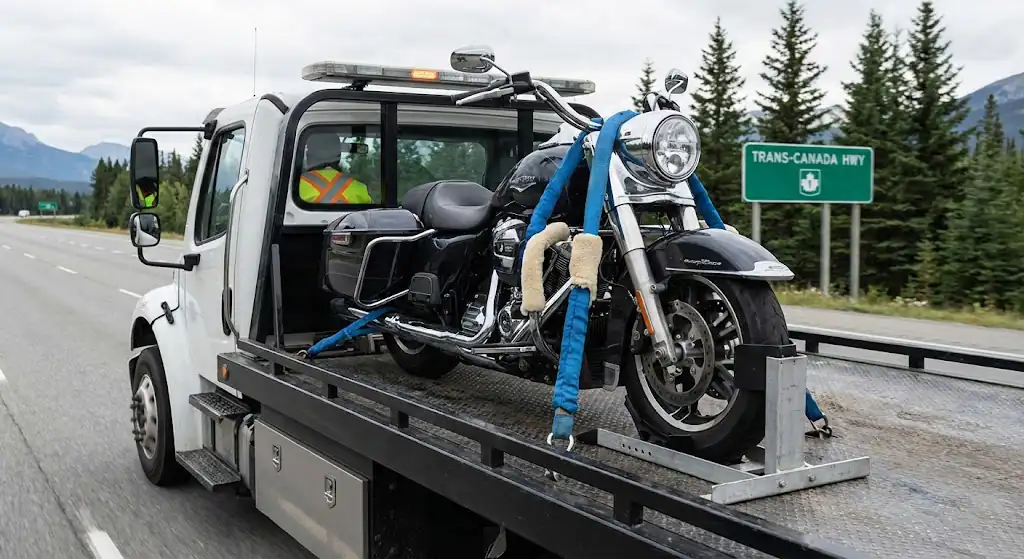
🏍️ Quick Answer: Motorcycle towing requires specialised equipment and technique that standard car towing does not. The safest method is flatbed towing — your bike is loaded onto a flat platform and secured with soft-loop straps at four points (handlebars and rear frame or passenger pegs) to prevent scratching, tipping, or drivetrain damage. Towing Toronto provides motorcycle towing across the GTA for all makes and types: cruisers, sportbikes, touring bikes, adventure bikes, scooters, and trikes. Emergency or scheduled — call (647) 812-1477 any time, 24/7.
Need your motorcycle towed? 24/7 flatbed motorcycle transport across the GTA.
Your motorcycle is not a car. It weighs less, it balances differently, it has exposed mechanical components, and the surfaces you care about — painted tanks, chromed exhausts, carbon-fibre fairings — are right there in the open, unprotected by body panels and bumpers. A car can survive being dragged onto a wheel-lift with minor indignity. A motorcycle handled the same way can sustain thousands of dollars in damage before it leaves the parking lot.
This is why motorcycle towing is a specialised service — and why calling a general towing company that “can probably fit a bike on there” is a gamble you should never take with a machine that matters to you. The difference between proper motorcycle towing and improvised bike hauling comes down to three things: the right equipment, the right securing technique, and an operator who has actually loaded a motorcycle before and understands how two-wheeled vehicles behave on a flatbed.
This guide covers how professional motorcycle towing works, what makes it different from car towing, how your bike should be secured during transport, what to do if your motorcycle breaks down on the road, and how to choose the right towing service for your specific type of bike.
Why Motorcycle Towing Is Fundamentally Different from Car Towing
A car sits on four wheels and is inherently stable. A motorcycle has two wheels and relies on either a kickstand or a centre stand to stay upright when not moving. This single difference changes everything about how the vehicle must be loaded, secured, and transported:
Balance and Stability
A motorcycle can fall over. During loading, during transport, and during unloading, the bike must be kept upright and stable at all times. This requires straps applying compression force to hold the suspension partially compressed so the bike cannot bounce or lean. A car just needs to be on the deck — a motorcycle needs to be actively held in place.
Exposed Components
Chrome, paint, carbon fibre, plastic fairings, and mechanical parts are all exposed. Using standard ratchet straps with metal hooks directly on handlebars, frame tubes, or bodywork will scratch and dent. This is why professional motorcycle towing uses soft-loop straps — fabric loops that wrap around the contact point before the ratchet strap hooks into the loop, never touching the bike directly.
Weight Distribution
A motorcycle’s weight is concentrated low and between the wheels. During transport, acceleration, braking, and turns shift this weight in ways that can cause the bike to rock or lean if not properly secured. The bike needs to be positioned on the flatbed with weight centred and straps applying even tension from both sides.
No Tow Hooks or Frame Points
Cars have designated tow hooks and frame attachment points. Motorcycles do not. Strap points must be carefully chosen — typically handlebars (at the triple clamp or handlebar base), rear frame rails, passenger pegs, or designated tie-down points on touring bikes. Strapping to the wrong point can bend components, stress frame welds, or damage suspension.
How Professional Motorcycle Towing Works: The Loading and Securing Process
When a Towing Toronto operator loads your motorcycle, here is the process — step by step. Understanding what should happen helps you verify that whoever is towing your bike is doing it correctly:
Flatbed Positioning and Ramp Deployment
The flatbed tow truck is positioned on level ground as close to the motorcycle as possible. The deck is tilted hydraulically and the ramp lowered. For bikes that cannot be ridden onto the ramp (engine dead, flat tyre, accident damage), the operator walks the bike up the ramp manually — engine off, in neutral, using the handlebars and rear subframe for control.
Front Wheel Chock Engagement
Once on the deck, the front wheel is rolled into a wheel chock — a metal or rubber cradle bolted to the flatbed that grips the front tyre and prevents forward/backward movement. The chock holds the bike upright while the operator secures the straps. Not all flatbeds have motorcycle-specific chocks — this is one of the things that separates a tow truck equipped for motorcycle towing from one that is improvising.
Soft-Loop Strap Attachment (Front)
Soft loops — short fabric straps that form a loop around the attachment point — are wrapped around the handlebars near the triple clamp (the strongest part of the handlebar assembly). The ratchet strap hook then clips into the soft loop, not the handlebar itself. Two front straps are attached: one on each side, running diagonally outward and down to the flatbed tie-down rails. This creates a V-pattern that holds the front end stable and the fork partially compressed.
Soft-Loop Strap Attachment (Rear)
Two rear straps are attached to the rear frame rails, passenger peg mounts, or designated tie-down points (touring and adventure bikes often have these). Again, soft loops first, then ratchet hooks into the loops. The rear straps pull diagonally outward and down, compressing the rear suspension slightly and preventing the back end from swaying laterally during transport.
Tension Check and Suspension Compression
All four straps are tightened evenly. The operator checks that the front fork is compressed 25–30% of travel — enough to hold the bike firmly without overloading the fork seals. The bike should not move when pushed from the side. If it rocks or bounces, the straps need adjustment. Over-tightening is as bad as under-tightening — too much tension can blow fork seals or bend handlebar clamps.
Final Verification and Transport
Transmission in gear (or park for automatic bikes) to prevent wheel rotation. Ignition off. Operator does a final walk-around, checks all four strap tensions, verifies the chock is secure, and checks that no loose items (mirrors, saddlebag contents, phone mounts) can vibrate free during transit. The flatbed is raised to level. During transport, the operator drives smoothly — no hard braking, gradual turns, and avoids potholes that could jar the bike.
Motorcycle Towing by Bike Type: What Your Ride Needs
Different motorcycle types have different weights, dimensions, tie-down points, and vulnerabilities. Here is how the towing approach varies by what you ride:
Cruisers (Harley-Davidson, Indian, Honda Shadow, Yamaha V-Star)
Cruisers are heavy — a Harley Road King weighs over 370 kg fully loaded. Low centre of gravity makes them stable on the flatbed, but the weight means the operator must have experience walking heavy bikes up the ramp. Chrome exhaust pipes, painted tanks, and leather saddlebags are all scratch-sensitive. Strap points are typically the handlebars and rear frame rails or passenger peg mounts. Saddlebags should be removed or emptied before transport if possible.
Sportbikes (Yamaha R1/R6, Honda CBR, Kawasaki Ninja, Ducati Panigale)
Sportbikes are lighter (typically 180–220 kg) but have plastic or carbon-fibre fairings that crack or shatter on impact. Clip-on handlebars sit below the triple clamp, making strap placement critical — straps should loop around the fork tube or triple clamp, not the clip-ons themselves which can bend under load. Rear strap points are usually the subframe rails or rear-set mounts. These bikes have aggressive lean angles, so the front wheel chock needs to accommodate the larger front fender gap.
Adventure and Touring (BMW GS, Honda Africa Twin, Goldwing, Harley Ultra)
The largest and heaviest motorcycles — a Honda Goldwing tips the scales at over 380 kg. These bikes often have factory-installed tie-down points or crash bars that serve as excellent strap anchors. Panniers and top cases should be removed before transport to reduce height and eliminate items that can shift. Tall adventure bikes like the BMW GS need extra clearance awareness — windscreens and hand guards add height that can catch on overhead structures during loading.
Scooters and Mopeds (Vespa, Honda PCX, Yamaha NMAX)
Scooters are lighter (80–180 kg) and have step-through frames with smaller wheels, making them less stable on a flatbed than full-size motorcycles. The strap points are limited — typically the frame rails under the floorboard and the rear grab handle. Plastic body panels are easily cracked by improper strap placement. Scooters are often towed for breakdowns or flat tyres — since most scooters do not carry spare tyres, a flat tyre means a tow.
Electric Motorcycles (Zero, Energica, LiveWire)
Electric motorcycles share the same flatbed towing requirements as gas bikes but add battery considerations. If the bike ran out of charge, it simply needs transport to a charging point. If it has been in a collision, the battery pack needs visual inspection for damage before loading — compromised lithium batteries require specific handling. Our operators follow EV-specific protocols for electric motorcycles, including the growing fleet of electric bikes on Toronto streets.
Your Bike Deserves Better Than “It’ll Probably Be Fine”
Flatbed equipped. Soft-loop straps. Wheel chock. Operators who know how to handle motorcycles. 24/7 across the GTA.
When You Need a Motorcycle Tow: Common Scenarios
Motorcycle towing covers both emergency situations and planned transport. Here are the most common reasons riders in the GTA call for a motorcycle tow:
What to Do When Your Motorcycle Breaks Down on the Road
A motorcycle breakdown is more exposed and more vulnerable than a car breakdown. You have no protective shell around you, you are harder for other drivers to see, and your bike is at risk of being knocked over by traffic or wind from passing vehicles. Here is what to do:
Get off the road immediately. Pull as far right as possible. If on a highway, get completely off the travel lanes and onto the shoulder. On city streets, pull into a parking lot, side street, or any space away from traffic. Park the bike on firm, level ground — soft gravel or uneven grass can cause a kickstand sink or tip-over.
Make yourself visible. Keep your helmet and high-visibility gear on. If you have reflective gear, wear it. At night, activate your phone’s flashlight or any light source to make yourself visible to approaching traffic. If the bike’s lights still work, leave the hazard indicators on (if equipped) or the tail light on with the ignition in accessory mode.
Secure the motorcycle. Put it on the kickstand or centre stand on firm ground. If the ground is soft (gravel, dirt, hot asphalt), place a flat object like a crushed can or a piece of cardboard under the kickstand to prevent sinking. Turn off the engine and fuel (if equipped with a petcock). Remove the key.
Move to a safe position. Stand well away from the bike on the side opposite traffic. Do not sit on the bike while waiting — if another vehicle strikes it, you do not want to be on it. On a highway, move behind the guardrail. For more safety tips, see our guide on waiting safely for a tow truck.
Call for a motorcycle tow. Call (647) 812-1477 and tell the dispatcher: your location, that it is a motorcycle (not a car), the make and model, and the nature of the problem. This ensures the operator brings the correct equipment — a flatbed with a wheel chock and soft-loop straps, not a wheel-lift designed for cars.
If your motorcycle has been in a collision, do not attempt to move it if there is visible frame damage, fluid leaks, or if doing so would aggravate an injury. Wait for professional assistance. For the full post-accident procedure, see our car accident guide for Toronto — the legal and insurance steps apply equally to motorcycle accidents.
Seasonal Motorcycle Transport: Spring De-Storage and Fall Storage Runs
Ontario’s riding season typically runs April through October — maybe November if you are brave and the weather cooperates. That means most motorcycles need transport at least twice a year: out of storage in spring and back into storage in fall. Here is how to make seasonal transport smooth:
🌱 Spring: Storage to Road
Late March through April is when riders want their bikes back. Book transport early — demand peaks sharply as temperatures rise above 10°C. If your bike has been stored properly (battery on tender, fuel stabiliser, tyres inflated), it should start after a few minutes of warming up. If it does not — dead battery, stale fuel, failed starter — the bike needs to be towed to a mechanic before you can ride. Have your destination ready: home garage, dealer for spring service, or a shop for the safety inspection if overdue. Confirm your insurance is renewed before the bike arrives — you cannot legally ride it even from the curb to the garage without active motorcycle insurance.
🍂 Fall: Road to Storage
October through November is fall storage season. If you can ride the bike to storage, great — but if the storage facility is far away, the weather is already bad, or the bike has a mechanical issue you are putting off until spring, scheduled motorcycle towing handles it. Before transport: fill the fuel tank and add fuel stabiliser, clean the bike thoroughly (road salt and grime corrode over winter), check tyre pressure, and ensure the battery is charged. At storage, the facility will typically disconnect the battery or put it on a tender. For winter preparation, see our seasonal guide.
Seasonal motorcycle transport is a scheduled service — you know the date in advance, so book 1–2 weeks ahead for guaranteed availability. Peak spring weeks (mid-April through Victoria Day weekend) are the busiest time for motorcycle towing in the GTA. For pricing on scheduled transport, see our towing cost and price guide or call for a quote.
How to Choose a Motorcycle Towing Company in Toronto
Not every towing company can safely handle a motorcycle. Here is what separates a proper motorcycle towing service from a general towing company that might damage your bike:
Ask: “Do you have a flatbed with a motorcycle wheel chock?” — if the answer is no, or they hesitate, they are planning to improvise. A proper motorcycle tow requires a flatbed (not a wheel-lift) and a wheel chock bolted to the deck. Without a chock, the operator has to hold the bike upright while strapping — a recipe for a dropped bike.
Ask: “Do you use soft-loop straps?” — metal ratchet hooks directly on handlebars and frame tubes scratch chrome, dent aluminium, and crack painted surfaces. Soft loops are non-negotiable for a motorcycle that you care about. Any towing company that does not carry them does not regularly tow motorcycles.
Ask: “How many motorcycles have you towed?” — experience matters more with motorcycles than with cars. Loading a bike is a physical skill — the operator needs to know how to walk a heavy motorcycle up a ramp without dropping it, where to place straps on different bike types, and how much tension to apply without overloading fork seals.
Verify TSSEA certification and insurance — this applies to all towing, but is especially important for motorcycles. If the operator drops your bike or damages it during loading, you need their insurance to cover the repair. A Harley-Davidson paint job alone can cost $2,000–$5,000. Verify the company is certified under Ontario’s Towing and Storage Safety and Enforcement Act and carries comprehensive insurance.
Confirm 24/7 availability — breakdowns do not happen on schedule. Some motorcycle-specific towing services in Toronto are appointment-only and do not operate after hours. If you need 24-hour towing, confirm that the company dispatches at night, on weekends, and on holidays.
For a broader guide to evaluating towing companies, see our post on how to choose a reliable towing company in Toronto. And to protect yourself from bad actors, read our towing scams guide.
Towing Toronto Motorcycle Towing Service
Towing Toronto provides motorcycle towing across the GTA — emergency and scheduled, all makes and types:
Flatbed Equipped for Motorcycles
Our flatbeds carry motorcycle-specific equipment: wheel chocks, soft-loop straps, and ratchet tie-downs rated for motorcycle weights. Every motorcycle tow uses the 4-point securing method — two front, two rear, all through soft loops. Your bike never touches a metal hook.
All Makes and Types
Harley-Davidson, BMW, Honda, Yamaha, Kawasaki, Suzuki, Ducati, Triumph, Indian, KTM, Aprilia, and every other manufacturer. Cruisers, sportbikes, touring bikes, adventure bikes, standards, café racers, scooters, mopeds, and trikes. If it has two or three wheels and a motor, we tow it.
Emergency and Scheduled
Broken down on the roadside right now? We dispatch 24/7. Need to move a bike from storage next Saturday? Book ahead for scheduled pickup. Both services use the same equipment and the same securing process — your bike gets the same level of care whether it is an emergency or a planned move.
GTA-Wide Coverage
We tow motorcycles across Toronto, Scarborough, North York, Etobicoke, Mississauga, Brampton, Markham, Vaughan, and beyond. For destinations outside the GTA, our long-distance towing covers Ontario-wide motorcycle transport.
Frequently Asked Questions
How much does motorcycle towing cost in Toronto?
Motorcycle towing cost depends on distance, time of day, and whether it is an emergency or scheduled pickup. Local motorcycle tows within the GTA typically cost less than car towing because the bike is lighter and loading is faster. For a transparent quote specific to your situation — pickup location, destination, bike type — call (647) 812-1477. We provide a price before dispatching, so there are no surprises when the truck arrives.
Can a regular tow truck tow a motorcycle?
A flatbed tow truck can, but a wheel-lift tow truck should not. Wheel-lift trucks cradle the vehicle’s wheels from below — this system is designed for cars and cannot safely stabilise a two-wheeled motorcycle. Some companies use a wheel-lift with a motorcycle cradle attachment, but this is a compromise. The gold standard for motorcycle towing is a flatbed with a bolted wheel chock and soft-loop 4-point strapping.
Will towing damage my motorcycle?
Not when done properly. Professional motorcycle towing with soft-loop straps, a wheel chock, and an experienced operator should result in zero damage to your bike. The soft loops prevent metal-on-metal or metal-on-paint contact, the 4-point strap pattern keeps the bike motionless during transport, and proper tension avoids overloading the fork seals. This is why choosing an experienced motorcycle towing provider matters — the technique prevents the damage.
Can you tow a motorcycle that has been dropped or is on its side?
Yes. Operators are trained to safely right a dropped motorcycle before loading. The technique depends on the bike’s weight and the situation — lighter bikes can be lifted by a single experienced operator, heavier touring bikes may require two people or a strap assist. Once upright, the bike is inspected for fluid leaks (oil, coolant, fuel) that could create a hazard during transport, then loaded and secured normally. If the bike is significantly damaged and cannot stand upright, it can still be strapped to the flatbed using frame points and additional support straps.
Do I need to be present for the motorcycle tow?
For emergency roadside tows, yes — you are typically with the bike when the tow truck arrives. For scheduled transport (storage runs, new purchase delivery), you do not necessarily need to be present at pickup if the bike is accessible and you have arranged access and payment in advance. Many motorcycle shops in the GTA have key-drop arrangements for after-hours deliveries. Confirm logistics with the dispatcher when booking.
Can you tow a motorcycle from a highway?
Yes. Highway motorcycle breakdowns are particularly dangerous because the bike is small and less visible to approaching traffic. We provide 24/7 emergency towing on all GTA highways including the 401, 400, 404, 403, 427, QEW, DVP, and Gardiner Expressway. If your bike breaks down on a highway, pull completely off the road, stay visible, and call immediately. The operator positions the flatbed upstream with amber lights activated, providing Move Over law protection while loading your bike.
Do you tow Harley-Davidsons?
Absolutely — Harleys are one of the most common motorcycles we tow in Toronto. From Sportsters to Road Glides, Street Glides, and Ultra Limited touring bikes. Harley-Davidsons require particular care because of their weight (many models exceed 300 kg), chrome exhaust systems, and painted bodywork. Our operators use soft loops on the handlebars and rear frame rails, and ensure chrome pipes and tank are not contacted by any strap or hardware during the entire transport.
Does motorcycle insurance cover towing?
Many Ontario motorcycle insurance policies include some roadside assistance or towing coverage, but limits vary significantly between insurers and policy types. Check your policy for towing coverage limits — some cover only $50–$100, which may not cover the full cost. If your motorcycle is being towed after a collision, direct insurance billing through your collision coverage typically handles the tow in full. Know your coverage before you need it.
Can you tow a trike or three-wheeled motorcycle?
Yes. Trikes (Can-Am Spyder, Harley Tri Glide, Honda Goldwing trike conversion) are inherently more stable than two-wheeled motorcycles and can often be loaded using a flatbed ramp without a wheel chock. The wider rear track requires proper positioning on the flatbed to ensure balanced weight distribution. Strapping is similar to a standard motorcycle — front and rear 4-point pattern through soft loops — but the rear straps attach to the trike’s frame rather than passenger pegs.
What should I do before the tow truck arrives to pick up my motorcycle?
If you have time before the tow truck arrives, a few steps help the process go smoothly. Remove loose items from the bike: phone mounts, GPS units, tank bags, saddlebag contents, and anything attached with Velcro or magnets that could fall off during loading or transport. If the bike is on a kickstand on soft ground, place something flat under the stand. Have your key available — the operator may need to put the bike in neutral for loading. If the bike has alarm or immobiliser, disarm it. And take photos of the bike’s condition before loading — this documents the state of the bike in case any damage occurs during transport.
Your Motorcycle. Treated Like It Matters.
Flatbed with wheel chock. Soft-loop straps. 4-point securing. Operators who have loaded hundreds of bikes. Emergency or scheduled — 24/7 across the GTA.
(647) 812-1477
📞 Call Towing Toronto Motorcycle Towing Service →
Recent Comments